

In 2026, trust is the most valuable asset a business can have online.
Before a customer calls your business, books your service, or clicks “Add to Cart,” they usually do one thing first: check your reviews. More often than not, they look at your Google Reviews.
Social proof is more important than ever. Traditional advertising is becoming less effective. Consumers are smarter, more cautious, and better informed than ever before. They don’t just want to know what a brand says about itself. They want to know what real customers think and experience.
The numbers speak for themselves. Around 93% of consumers read online reviews before making a purchase, and 97% check reviews before choosing a local business. Reviews influence 32% of purchase decisions, making them more impactful than discounts or coupons. When it comes to trust, 88% of consumers value online reviews as much as recommendations from friends and family.
Despite this, many businesses are missing a major opportunity. Their Google Reviews are available on their Google Business Profile, but they are not displaying them on their website.
This guide explains why embedding Google Reviews on your website can significantly improve conversions. You’ll learn the psychology behind customer trust, see the statistics that support it, and follow a step-by-step process to display reviews effectively on your website.
What Are Google Reviews and Why Do They Matter?
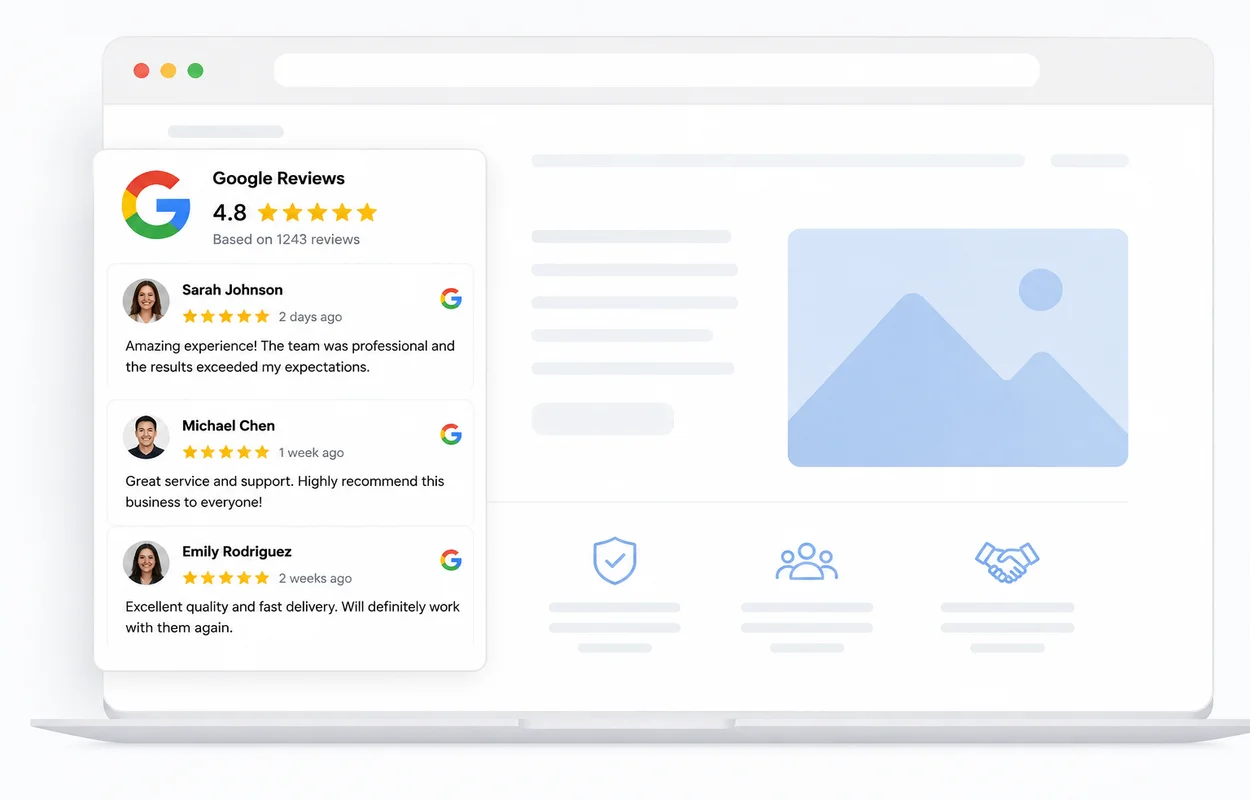
Understanding Google Reviews
Google Reviews are ratings and feedback left by customers on a business’s Google Business Profile (GBP). This is the business information panel that appears when people search for a company on Google Search or Google Maps.
Customers can leave a star rating from 1 to 5 and share details about their experience. These reviews are publicly visible and help build a business’s online reputation over time.
Google is the leading review platform, accounting for nearly 58% of all online reviews. Other platforms like Facebook, Yelp, and TripAdvisor also host reviews, but Google remains the first place most customers look when researching a business.
Because of its reach and visibility, Google Reviews often shape a customer’s first impression before they visit your website, contact your business, or make a purchase.
How Reviews Influence Buying Decisions
Today’s customer journey is rarely straightforward. People often interact with your business through multiple channels before making a decision. Reviews play an important role throughout this process.
Discovery Stage
A potential customer searches for terms like “best dentist near me” or “top marketing agency in my area.” Before visiting any website, they see star ratings and reviews in Google Search and Google Maps.
Consideration Stage
After finding your business, they visit your website to learn more. If they cannot easily find reviews on your website, they may leave and search for them elsewhere.
Decision Stage
When comparing multiple businesses, factors such as review ratings, review volume, and how recently reviews were posted often influence the final decision.
Research shows that 81% of consumers use Google Reviews to evaluate local businesses, and 74% are more likely to trust a business with positive reviews.
Why Reviews Matter for Conversions
Reviews help reduce uncertainty. They answer common questions, provide reassurance, and show real customer experiences.
When visitors see positive reviews at the right moment, they feel more confident about choosing your business. This reduces hesitation and speeds up decision-making.
The connection between trust and conversions is simple. The fewer doubts customers have, the more likely they are to take action. Whether it’s making a purchase, booking a service, or requesting a quote, reviews help move people from consideration to conversion.
Unlike traditional sales efforts, reviews work continuously. They build credibility, strengthen trust, and influence buying decisions around the clock, even when your team is offline.
What Does It Mean to Embed Google Reviews on Your Website?
Google Reviews Widget Explained
Embedding Google Reviews on your website means pulling your live Google Reviews and displaying them directly within your website’s pages , not just linking to your Google profile. A Google Reviews widget is a piece of code (usually JavaScript) that connects to your Google Business Profile data and renders your reviews inside a styled display block on your site.
The critical distinction: linking to reviews versus displaying reviews on-site is the difference between asking your visitor to leave your site and trust someone else’s platform, versus giving them the confidence they need right where they’re already browsing. Keeping visitors on-site during the trust-building phase is essential to conversion.
Widgets can display reviews in several formats: sliders/carousels, grid layouts, masonry lists, badge displays, or single highlighted review callouts. Most are customizable to match your brand’s color scheme and typography.
Where Businesses Typically Display Reviews
Strategic placement matters as much as the reviews themselves. High-performing businesses display Google Reviews on:
- Homepage: Establishes credibility immediately for first-time visitors
- Product pages: Reduces hesitation at the point of consideration
- Service pages: Validates your expertise for service-based businesses
- Landing pages: Supports ad campaigns and offers proof to warmed traffic
- Checkout pages: Catches last-minute doubts before purchase completion
- Contact/booking pages: Reassures visitors before they take the final step
7 Ways Embedding Google Reviews Boosts Website Conversions
1. Builds Instant Trust and Credibility
You have approximately 7 seconds to make a first impression on a new website visitor before they decide whether to stay or leave. In that window, nothing communicates “we’re the real deal” faster than a gallery of authentic customer experiences.
Displaying Google Reviews on your homepage or hero section immediately signals that real people have done business with you and were satisfied enough to write about it publicly. This is especially powerful for new businesses or brands with limited marketing budgets — reviews let your customers do the selling for you.
74% of consumers say they trust a business more when it displays positive Google Reviews. Trust is the single biggest barrier between a visitor and a conversion. Once removed, everything else becomes easier.
2. Provides Powerful Social Proof
Social proof is one of the most fundamental principles in consumer psychology, popularized by Robert Cialdini in Influence: The Psychology of Persuasion. Humans are social creatures. When uncertain about a decision, we look to what others have done as a guide to the “correct” behavior.
When a website visitor sees 150+ Google Reviews averaging 4.8 stars, an internal signal fires: “If all these people made this choice and were happy, it must be the right one.” This isn’t rational analysis — it’s instinctive crowd-following that happens in seconds.
The data backs this up: products with 5 or more reviews have a 270% higher conversion rate than products with no reviews. And for luxury items, that number jumps to 380%. Social proof is especially effective for higher-ticket items where the perceived risk of a wrong decision is highest.
3. Reduces Purchase Anxiety
Every potential customer carries some degree of purchase anxiety — the fear of making a mistake, wasting money, or being disappointed. This anxiety increases with price point, complexity of the purchase, and unfamiliarity with the brand.
Reviews directly address this anxiety by giving visitors a vicarious experience of what it’s like to be your customer. A review that says “The onboarding was seamless and support answered all my questions within an hour” eliminates a specific concern a potential customer might have been nursing silently.
On-site reviews increase conversions by up to 74%, in large part because they provide the specific reassurances visitors need at exactly the moment they need them. Unlike a salesperson’s pitch, a customer review carries no motive for exaggeration — and visitors know this.
4. Increases Time Spent on Website
Interactive review feeds and carousels create natural engagement loops. Visitors scroll, read individual reviews, filter by rating, and explore specific experiences relevant to their situation. This behavior increases dwell time — the amount of time a visitor spends on your site.
Dwell time matters for two reasons:
First, it correlates directly with conversions. A visitor who spends four minutes reading your reviews is far more likely to convert than one who bounced after fifteen seconds. Engagement implies genuine interest and active consideration.
Second, higher engagement and lower bounce rates send positive behavioral signals to search engines, which can contribute indirectly to better organic rankings over time.
5. Strengthens Local SEO Signals
Embedding Google Reviews on your website does more than impress visitors — it signals to search engines that your site contains fresh, relevant, user-generated content about your business.
Google has explicitly stated that reviews are a factor in local search ranking, contributing to what it calls “prominence” — one of the three main factors (alongside relevance and distance) that determine where your business appears in local searches and the Google Maps “Local Pack.”
Reviews account for approximately 10% of local SEO ranking factors. Businesses with 50+ reviews and a 4.5+ star rating see up to 30% better visibility in local search rankings. When embedded reviews include naturally-occurring keywords (e.g., “best dentist in Austin” or “fast overnight shipping”), they also provide keyword-rich content that can help pages rank for relevant long-tail terms.
Additionally, embedding reviews with proper schema.org structured data markup can trigger rich snippets — those gold star ratings you see beneath listings in Google Search organic results. Rich snippets have been shown to increase click-through rates by 10–17%.
6. Improves Product and Service Page Performance
The highest-converting placement for reviews isn’t always the homepage. For e-commerce sites and service businesses, reviews embedded near calls-to-action (CTAs) on product and service pages are the most powerful conversion lever.
A visitor on your “Web Design Services” page is already interested — they just need the final push to fill out your contact form. A carousel of Google Reviews directly above or below your CTA button provides that push.
Adding a Google review badge near CTA buttons or checkout pages can significantly improve conversions. Reviews answer the question visitors are silently asking: “Has this worked for people like me?”
7. Creates a Competitive Advantage
Here’s a simple scenario that plays out thousands of times a day: a consumer compares two businesses side by side. One has 47 reviews at a 4.7-star average prominently displayed on its website. The other has 12 reviews buried on a third-party site. The first business wins — not necessarily because their service is superior, but because their trust architecture is stronger.
Only 13% of consumers will even consider a business with a 1–2 star rating. And 59% of customers won’t trust a star rating unless the business has more than 20 reviews. Businesses that proactively display their reviews are not just showing off — they’re removing competitive vulnerabilities before a prospect even knows they exist.
The Psychology Behind Reviews and Conversions
Social Proof Theory
Social proof theory, formalized by psychologist Robert Cialdini, holds that people determine correct behavior by observing the behavior of others — especially in situations of uncertainty. For consumers browsing an unfamiliar website, uncertainty is the default state. Reviews short-circuit that uncertainty by providing a ready-made consensus.
The more reviews a business has, the stronger the social proof signal. This is why businesses with 100+ reviews convert at dramatically higher rates than those with fewer than 10 — even if the average star rating is identical.
Trust Signals and Risk Reduction
Purchasing anything online involves a perceived risk: will this product work? Will this company follow through? Will I regret this? Reviews are among the most effective trust signals because they represent third-party validation — information that can’t be fabricated by the seller and comes from people with no vested interest in the transaction.
Emotions drive up to 70% of purchase decisions, and the most powerful emotion reviews address is fear. A well-placed set of detailed, authentic reviews systematically reduces the fear-based friction that prevents conversions.
Fear of Missing Out (FOMO)
When a product or service has hundreds of glowing reviews, it implies that many people are already enjoying its benefits and that the reader risks being left behind. FOMO is a well-documented psychological driver in consumer behavior, and review volume amplifies it naturally.
A review that says “I waited too long to try this — wish I’d found it sooner” is a FOMO trigger embedded in authentic customer language, more persuasive than any marketing copy could be.
Consensus Bias in Consumer Behavior
Consensus bias sometimes called the bandwagon effect is the tendency to assume that if many people believe or do something, it must be correct. High review counts and strong aggregate ratings tap directly into this bias, making the choice to purchase feel like the safe, rational, majority-approved decision rather than a risk.
Key Statistics That Prove Reviews Influence Conversions
Here is a consolidated view of the most compelling, current data on the impact of reviews:
Consumer Trust:
- 93–95% of consumers read online reviews before making a purchase decision
- 88% trust online reviews as much as personal recommendations
- 74% trust businesses more when they display positive Google Reviews
- 83% of consumers read Google Reviews specifically before making a buying decision
- 73% only trust reviews written within the last 30 days
Conversion Impact:
- Displaying reviews can boost sales by up to 19.8%
- Products with 5+ reviews see a 270% higher conversion rate (380% for luxury items)
- On-site reviews increase conversions by 74%
- Every 10 new reviews improves conversion rates by approximately 2.8%
- Reviews can lift website conversion rates by 15–20%
Revenue Impact:
- A one-star rating increase can boost revenue by 5–9%
- Positive Google Reviews are linked to up to 18% revenue growth
- One unaddressed negative review can cost a business up to 30 customers
Volume and Recency:
- Top-ranking businesses on Google average ~47 reviews
- Businesses with 100+ reviews rank 20% higher in local search packs
- 56% of customers are attracted to brands that respond to their reviews
- 59% won’t trust a star rating unless the business has more than 20 reviews
Mobile and Local:
- 97% of consumers read reviews before selecting a local business
- 60% of local searches are conducted on mobile devices
- 81% of consumers use Google Reviews to evaluate local businesses
- Google commands ~57–58% of all online reviews
Best Places to Display Google Reviews on Your Website
Where you place your Google Reviews can have a significant impact on how effectively they build trust and drive conversions. Here are the best locations to showcase them.
Homepage
Your homepage is often the first interaction visitors have with your business. People may arrive through search engines, social media, referrals, or paid ads. Displaying Google Reviews on your homepage helps establish credibility right away and creates a positive first impression.
Benefits:
- Lower bounce rates
- Increased time on site
- More clicks to key pages
Product Pages
For eCommerce businesses, product pages are one of the most effective places to display reviews. At this stage, visitors are already interested in a product and are looking for reassurance before making a purchase.
Reviews help answer important questions about product quality, performance, and customer satisfaction.
Benefits:
- Higher add-to-cart rates
- Better purchase confidence
- Reduced product returns
Service Pages
Service-specific reviews can be extremely persuasive for agencies, consultants, healthcare providers, contractors, and other service-based businesses.
When potential customers see reviews that mention the exact service they are considering, it helps remove doubts and strengthens confidence in your expertise.
Benefits:
- More contact form submissions
- Increased quote requests
- Higher lead conversion rates
Pricing Pages
Pricing pages are often where visitors decide whether your offering is worth the investment. Adding customer reviews near pricing information helps reinforce value and provides reassurance before they make a decision.
Benefits:
- Reduced page abandonment
- Increased plan upgrades
- Improved conversion rates
Checkout Pages
Many shoppers abandon their carts before completing a purchase. Displaying Google Reviews near the checkout button can provide a final layer of confidence and encourage visitors to complete their order.
Even a simple review badge or star rating can make a difference.
Benefits:
- Lower cart abandonment
- Higher order completion rates
- Increased customer confidence
Contact Pages
Visitors who reach your contact page are usually close to taking action. A small review section or Google Reviews widget can reassure them that contacting your business is the right decision.
Benefits:
- More form submissions
- Increased phone calls
- Higher inquiry rates
How to Embed Google Reviews on Your Website
There are several ways to display Google Reviews on your website. The right option depends on your goals, budget, and technical requirements.
Method 1: Use a Google Reviews Widget
For most businesses, using a Google Reviews widget is the easiest and most effective solution.
These widgets connect directly to your Google Business Profile and automatically display your latest reviews on your website.
Advantages:
- Automatic review updates
- Easy customization
- Mobile-friendly design
- Review moderation options
- Multiple display layouts
Popular Tools:
- Tagembed
- Taggbox
- EmbedSocial
- Flockler
- EmbedReviews
- WidgetBox
Method 2: Add Reviews Manually
You can also copy reviews from Google and display them as testimonials on your website.
While this method is simple, it requires regular updates and does not show live ratings or verified review information.
Best For:
- Small websites
- Featured customer testimonials
- Limited review collections
Method 3: Use a Review Aggregator
Review aggregation platforms collect reviews from multiple sources such as Google, Facebook, Yelp, and Trustpilot and display them in a single widget.
This approach is useful for businesses that receive reviews across several platforms.
Best For:
- Multi-platform review management
- Businesses with reviews across multiple channels
Step-by-Step Guide to Embedding Google Reviews with Tagembed
Step 1: Connect Your Google Business Profile
Create a Tagembed account and click Add Widget. Select Google Reviews as your source and sign in with your Google account. Then choose the business profile you want to display.
Step 2: Customize Your Widget
Choose a layout such as Grid, Slider, List, or Badge. Customize colors, fonts, spacing, and other design elements to match your website.
You can also choose how many reviews to display and whether to show reviewer names and profile photos.
Step 3: Moderate Your Reviews
Use Tagembed’s moderation features to control which reviews appear on your website. You can filter reviews by rating, keywords, or relevance to maintain a clean and professional display.
Step 4: Embed the Widget
Copy the generated embed code and paste it into your website where you want the reviews to appear.
Tagembed supports popular platforms including WordPress, Shopify, Wix, Squarespace, Webflow, and custom websites. Once installed, the widget automatically updates whenever new Google Reviews are published.
Why a Google Reviews Widget Is Essential for Modern Websites
Displaying Google Reviews on your website is important, but manually updating them can be time-consuming. A Google Reviews widget solves this problem by automatically pulling reviews from your Google Business Profile and displaying them in real time.
Automatic Review Updates
One of the biggest advantages of a Google Reviews widget is automation. Every new review you receive is automatically displayed on your website without requiring any manual updates.
This means your social proof stays current while saving valuable time and effort.
Real-Time Social Proof
Customers trust recent reviews. In fact, many consumers pay attention to how recently a review was posted before making a decision.
A live review widget ensures visitors always see fresh customer feedback, helping your business appear active, reliable, and trustworthy.
Better Website Experience
Modern review widgets are designed to blend seamlessly with your website.
Most tools allow you to:
- Match your brand colors and fonts
- Choose from multiple layouts
- Optimize reviews for mobile devices
- Display ratings, photos, and customer feedback in an attractive format
This creates a professional experience while making reviews easier to browse and read.
Scales as Your Business Grows
As your business collects more reviews, a widget grows with you. Whether you have 20 reviews or 2,000, your widget can automatically display and organize them without additional work.
For businesses with multiple locations, many widgets can even combine reviews from different Google Business Profiles into a single display.
Frequently Asked Questions
Do Google Reviews Increase Conversions?
Yes. Customer reviews help build trust and reduce purchase hesitation. Studies consistently show that businesses displaying reviews experience higher engagement and conversion rates compared to those that don’t.
Reviews are especially valuable for service businesses, local businesses, and high-ticket purchases where trust plays a major role in the buying decision.
Where Should I Display Google Reviews?
The most effective locations include:
- Homepage
- Product pages
- Service pages
- Pricing pages
- Checkout pages
- Contact pages
Place reviews where customers are making important decisions rather than hiding them on low-traffic pages.
Can Google Reviews Help SEO?
Yes. Google Reviews can support SEO in several ways:
- Improve local search visibility
- Increase click-through rates through review-rich search results
- Add fresh user-generated content to your website
- Strengthen your Google Business Profile’s authority
While reviews alone won’t guarantee higher rankings, they contribute to a stronger local SEO strategy.
How Often Should Reviews Be Updated?
Ideally, reviews should update automatically whenever new feedback is received.
A live Google Reviews widget ensures visitors always see the latest customer experiences without requiring manual updates.
What Is the Best Google Reviews Widget?
The best solution depends on your website platform and requirements.
Popular options include:
- Tagembed
- Taggbox
- EmbedSocial
- EmbedReviews
- Flockler
Look for features such as customization, moderation, responsive design, and automatic updates.
Are Google Reviews Better Than Testimonials?
Both are valuable, but Google Reviews often carry more credibility because they come from verified third-party profiles.
Testimonials give you more control over presentation and storytelling, while Google Reviews provide authenticity and transparency.
For the best results, use both together on your website.
Conclusion
Google Reviews have become one of the most influential factors in modern purchasing decisions. They help potential customers evaluate your business, build confidence, and make informed choices.
However, reviews are most effective when they are visible on your website. By embedding Google Reviews on key pages, you can showcase authentic customer experiences exactly where visitors are making decisions.
A Google Reviews widget makes this process simple. It automatically displays fresh reviews, keeps your social proof up to date, and helps create a more trustworthy website experience.
Whether you’re running an eCommerce store, local business, agency, or SaaS company, displaying Google Reviews can help increase credibility, improve engagement, and drive more conversions.
The sooner you start showcasing customer feedback on your website, the sooner you can turn visitor trust into business growth.



Leave a Reply