

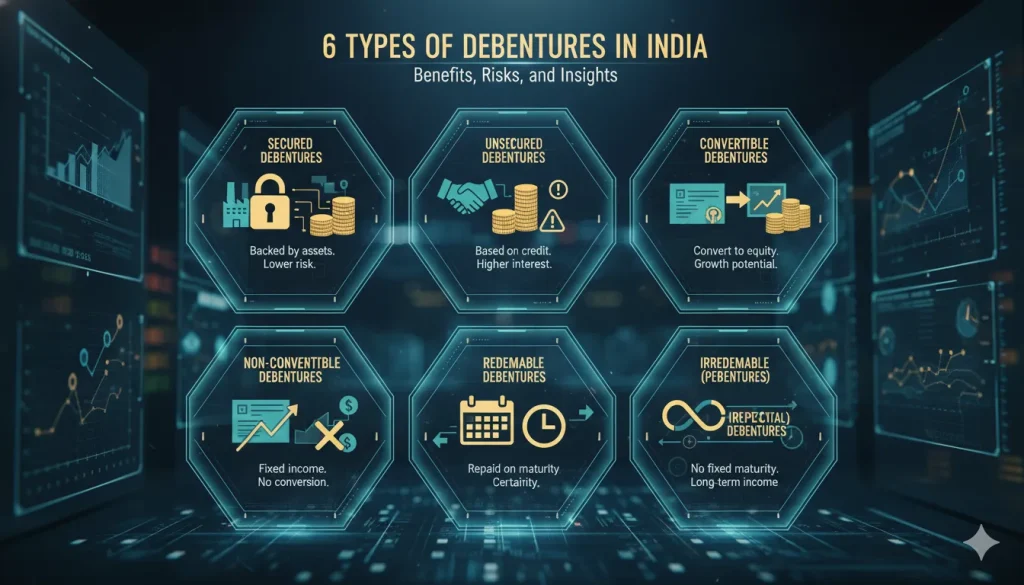
The Indian financial market provides various investment opportunities among which investors can choose debentures. The different types of debentures together with their advantages and disadvantages which investors need to know about must be studied before making an investment.
What is a Debenture?
A debenture represents a financial agreement in which a company borrows money from investors through this instrument. The company will pay interest at a predetermined rate and will return the principal amount after a specified duration. Debenture holders do not receive ownership rights in the company like shareholders do. Debenture holders obtain rights to company assets in case the company experiences financial difficulties.
The regular interest payments made by debentures qualify them as fixed-income investments.
6 Types of Debentures in India
Debentures can be classified based on security and convertibility and repayment features. The main types of debentures include:
1. Convertible Debentures
These debentures become convertible into company shares after reaching a designated time period.
Benefits:
The investor receives predictable interest payments up until the conversion takes place.
The company increase provides potential profit opportunities.
Risks:
The stock market experiences fluctuations which result in price changes.
The company performance determines the value of the shares after they have been converted.
2. Non-Convertible Debentures (NCDs)
NCDs cannot become shares through conversion and they provide interest payments until their maturity date.
Benefits:
The investor receives consistent interest payments.
Investing in this option presents less risk compared to stock investments.
Risks:
The established interest rate may result in lower earnings compared to stock market investments.
The company faces default risk because it cannot pay its debts.
3. Secured Debentures
These debentures obtain their backing from the financial resources of the company. Investors hold the right to claim company assets in case of nonpayment by the company.
Benefits:
These investments offer greater safety compared to their unsecured counterparts.
There exists a decreased possibility of financial loss.
Risks:
The borrower will receive reduced interest payments from lenders.
The process of recovering assets from a struggling company will take an extended period.
4. Unsecured Debentures
Investors face asset-backed risk because unsecured debentures lack any asset-based protection. Investors need to depend on the company’s ability to repay debts.
Benefits:
Secured debentures usually provide lower interest rates.
Companies find it simpler to create these financial products.
Risks:
Investors face increased danger from corporate defaults.
Investors will lose all their money because they possess no asset protection.
5. Redeemable Debentures
These debentures must be repaid on the designated repayment day. The financial products come with two options which include secured and unsecured assets.
Benefits:
The repayment terms of this agreement provide an organized payment structure.
The borrower will receive interest payments at scheduled intervals.
Risks:
The real returns will decrease because of rising inflation.
The company faces the possibility of defaulting on its financial obligations.
6. Irredeemable or Perpetual Debentures
These debentures operate without any designated payment date. The company makes interest payments forever but it returns the principal amount only when it chooses to repay.
Benefits:
The investor receives continuous income through interest payments.
The investment suits long-term investors who prioritize income generation.
Risks:
The absence of a set maturity date will create problems for investors who need to convert their assets into cash.
The company must maintain its operational capacity to meet its interest payment commitments.
Tips for Investors
Before making an investment in debentures, investors need to evaluate these factors:
Interest Rates: Choose the best interest rate to achieve maximum returns.
Company Health: Assess the financial strength of the company.
Investment Duration: Choose the appropriate debenture type to achieve your investment objectives.
Taxes: Interest income becomes taxable according to established financial regulations.
Investors through their strategy of diversifying debenture investments will achieve two objectives which include decreasing investment risks and establishing an even distribution of income.
Conclusion
In India debentures serve as an effective investment choice. Each type of debenture including convertible and perpetual debentures possesses its unique characteristics which provide specific advantages and disadvantages. The meaning of debentures together with their various categories enables investors to select appropriate investment options while creating effective financial plans.